
Geography as a discipline
By admin
Related Course
Geography Class 11th
FREE
Chapter 1: Geography as a Discipline
Fundamentals of Physical Geography - Class 11 NCERT
Geography is an ever-evolving field that serves as a bridge between the natural sciences and social sciences. These notes provide an in-depth, systematic coverage of the chapter, optimized for clarity and academic excellence.
1. The Nature of Geography
The word Geography was coined by Eratosthenes, a Greek scholar. The discipline is defined by its focus on the Earth as the home of mankind. It is not merely a collection of facts about rivers and mountains; it is the study of Areal Differentiation—understanding why things differ from one place to another.
Geography studies the spatial organization and spatial expression of various phenomena. It looks at the Earth from a holistic perspective, acknowledging that everything on the planet is interconnected.
2. Geography as an Integrating Discipline
Geography is an integrative discipline that has interface with numerous natural and social sciences.
Spatial Synthesis
Geography attempts a spatial synthesis, meaning it puts together information from various fields to understand a specific location. For example, to understand the agriculture of a region, a geographer combines knowledge of geology (soil), meteorology (rainfall), and economics (market).
The Interface with Other Sciences
- Relation with Natural Sciences: Physical Geography is linked with Geology (study of rocks), Meteorology (atmosphere), Hydrology (water), and Pedology (soil).
- Relation with Social Sciences: Human Geography is linked with History (temporal changes), Sociology (social structures), Economics (production and consumption), and Political Science (territories).
3. Approaches to the Study of Geography
There are two major academic approaches to studying geography:
-
The Systematic Approach
Introduced by Alexander von Humboldt, this approach follows a particular phenomenon. Example: Studying "Natural Vegetation" globally across the entire Earth.
-
The Regional Approach
Developed by Karl Ritter, this approach views the world as a collection of regions. Example: Studying "South Asia" and looking at its climate, population, and economy within that specific boundary.
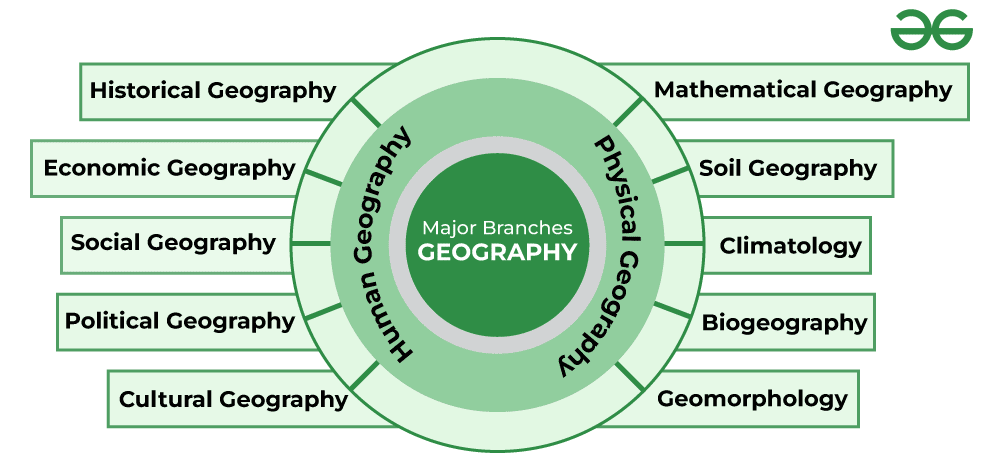
4. Branches of Geography (Systematic Approach)
I. Physical Geography
- Geomorphology: The study of landforms and their evolution.
- Climatology: The study of atmosphere, weather, and climate types.
- Hydrology: The study of the realm of water (oceans, rivers, lakes).
- Soil Geography: The study of soil formation processes and distribution.
II. Human Geography
- Social/Cultural Geography: The study of society and its spatial dynamics.
- Population and Settlement Geography: Studies population density, distribution, and settlement types.
- Economic Geography: Studies agriculture, industry, tourism, and trade.
- Historical Geography: Studies how history shapes current geographical features.
III. Biogeography
- Plant Geography: Spatial patterns of natural vegetation.
- Zoo Geography: Geographic characteristics of animals and habitats.
- Ecology: Scientific interaction between species and environment.
- Environmental Geography: Focuses on conservation and management.
5. Modern Tools and Techniques in Geography
The discipline has been revolutionized by technology:
- Cartography: The science of map-making (now digital).
- Remote Sensing: Obtaining data via satellites or aircraft.
- GIS (Geographical Information System): Computer systems for spatial data management.
- GPS (Global Positioning System): Satellite-based location tracking.
6. Physical Geography and its Importance
The study of physical geography is vital for understanding:
- Lithosphere: Minerals, soil, and land for settlements.
- Atmosphere: Air and climatic conditions.
- Hydrosphere: Water resources for life and energy.
- Biosphere: Ecological balance and biodiversity.
7. Major Questions Asked by Geographers
- What: Identification of features.
- Where: Distribution of features.
- Why: The causal relationship (the core of scientific geography).
Summary Checklist: Geography is a description of the Earth as a home for humans. It uses Systematic (Humboldt) and Regional (Ritter) approaches and relies on modern tools like GIS and Remote Sensing.



Share this article: